Hi-Lo Casino UK: How the Card Calls Work
 Available in GB
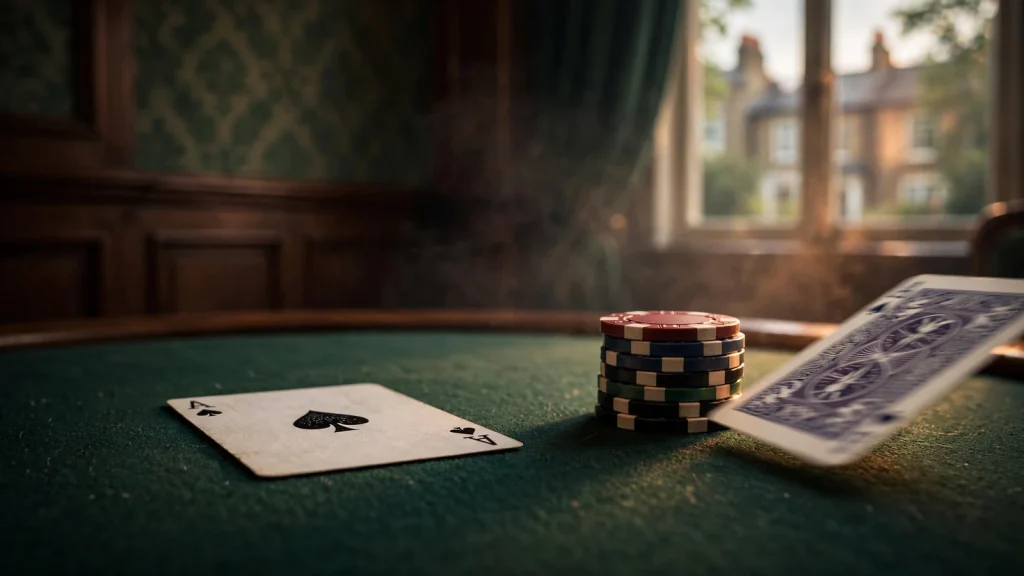
Each revealed winning card sets the reference for the next higher-or-lower choice, with rules varying across live, online and reel games.
Table of Contents
- How Hi-Lo Works: The Card That Sets Up the Next Call
- Live Hi-Lo: Burn Cards, Continuous Shuffling and the Exposed Card
- Live Hi-Lo Sites: What the Card Rules Mean for Your Bets
- Choosing a Hi-Lo Casino Without Falling for the ‘Best’ Label
- Hi-Lo Online: A Single Deck, No Replacements
- Hilo Strategy: When to Stop, and What the Return Figures Say
- Hi-Lo as a Reel Game: Direction, Ties and Parlaying
- Hi-Lo Casino Sites in the UK: Check the Licence Before You Deposit
- How to Play Draw Hi-Lo Without Guessing Blind
- Live Games
How Hi-Lo Works: The Card That Sets Up the Next Call
Hi-Lo gives you a simple choice: look at the current card and predict whether the next one will be higher or lower. Some versions also let you call the same value. That is the whole decision in its basic form, but the card you are judging against matters just as much as the call itself.
The important detail is that a round’s winning card does not disappear from the story once that hand ends. It remains exposed and becomes the reference card for the next round. You are not starting each decision from a fresh, unrelated point; the latest revealed winner sets the comparison for the next higher-or-lower call.
That makes the game easy to follow, but not quite as automatic as it first sounds. You see a card, choose a direction, then the next card supplies the answer. After that, the newly exposed winning card becomes the starting reference for the following decision. The rhythm is card, call, result, new reference. Simple to grasp. Easy to rush.
When choosing a hi-lo casino in the UK for 2026, payout timing is one practical detail to check. Use these verdicts as a brief reference for the withdrawal timeframe provided for each operator.
1. BeOnBet
Payout speed: 1-3 business days BeOnBet lists a payout speed of 1–3 business days, giving you a stated timeframe to consider.
2. EvoSpin
Payout speed: 1-3 business days EvoSpin lists a payout speed of 1–3 business days, a useful detail for your choice.
3. Revery Play
Payout speed: 1-3 business days Revery Play lists a payout speed of 1–3 business days, so you have a stated withdrawal timeframe to take into account.
4. NightLuck
Payout speed: 1-3 business days NightLuck lists a payout speed of 1–3 business days, which gives you a clear timeframe to consider.
5. Zombillion
Payout speed: 1-3 business days Zombillion lists a payout speed of 1–3 business days, providing you with a stated timing detail.
6. Dieselwin
Payout speed: 1-3 business days Dieselwin lists a payout speed of 1–3 business days, a practical point for you to factor into your selection.
7. SpinFormula
Payout speed: 1-3 business days SpinFormula lists a payout speed of 1–3 business days, giving you a stated timeframe for payouts.
8. NightWin
Payout speed: 1-3 business days NightWin lists a payout speed of 1–3 business days, a useful timing detail for you to note.
9. Britsino
Payout speed: 1-3 business days Britsino lists a payout speed of 1–3 business days, giving you a stated timeframe to consider.
10. WinBeast
Payout speed: 1-3 business days WinBeast lists a payout speed of 1–3 business days, providing a stated withdrawal timeframe for your consideration.
I used to treat the choice as if it were just a snap judgement: glance at the card and pick a side. But the useful habit is to pause long enough to make sure you know which card is currently setting the comparison. It sounds obvious, yet in a quick sequence it is easy to carry the previous decision in your head instead of looking at the card that now matters.
The optional same-value call changes the set of choices, not the central idea. You are still comparing the next card with the exposed reference card; the difference is that some versions let you include an equal value as a possible outcome. If that option is not offered, the decision is between higher and lower. The rules on screen are what count for the version you are playing.
This is why “Hi-Lo” can describe games that share a recognisable idea without having every detail in common. The core is the comparison, while the format determines what choices are available and how a round proceeds. If you have only played one version, it is safer not to assume that another handles every edge case the same way.
For a first look at a Hi-Lo casino game, keep your attention on the current reference card and the direction you are being asked to predict. Then check whether the version offers a same-value choice. Those are the essentials behind the call; the rest depends on the particular game’s rules. A small decision, repeated.
Live Baccarat Online in the UK: Tables and Rules
Live Hi-Lo: Burn Cards, Continuous Shuffling and the Exposed Card
The live version of Hi-Lo has a different feel from a simple draw game because the cards are handled as part of a continuing shoe. The key details are the deck setup, the burn cards and the continuous shuffler. Together, they explain why the card you can see is only one part of what is happening behind the next reveal.
A specialist review describes the game as using six decks of 48 cards, with the tens removed from each deck. It also says the exact deck count could not be confirmed in writing. That distinction matters: the six-deck arrangement is a description from that review, not a detail confirmed in writing. I would not treat it as a settled specification for every live Hi-Lo table.
Removing the tens changes the composition of the shoe compared with an ordinary full deck. The setup described has cards of other ranks, but no tens. That is relevant when you are trying to understand what may be drawn; it is not just a decorative detail on the table. Still, without written confirmation of the deck count, the six-deck description should be read with care rather than turned into a blanket claim about live Hi-Lo.
There is another visible feature: three cards are burned before the next winning card is revealed. A burn is a card taken out of the sequence of cards shown as the result. So the next card you see as the winning card does not simply follow the previous winning card without anything happening in between. The intervening cards are part of the dealing process, even though they are not revealed as the result.
In the live setup described, three cards are burned before the next winning card is revealed, creating a gap in the visible sequence.
That can be easy to miss if you think of the game as one card appearing directly after another. In the live setup described, there is a gap in that visible sequence. Three cards are burned, then the next winning card is revealed. The burn procedure is separate from the reference-card rule: the previous winning card remains exposed and serves as the reference for the next round.
The exposed card is the part of the previous result that carries forward. Once a winning card has been revealed, it stays visible as the card against which the next round is framed. The shoe may be changing behind the scenes, but the reference point on screen is clear. That gives the live game a repeated rhythm: a result appears, it remains in view, and the next round uses it as its starting reference.
The cards themselves do not simply sit aside until a long sequence has been dealt. A continuous shuffler is used, and cards from the previous round are returned to it immediately. In other words, the previous round’s cards go back into the shuffling process rather than remaining out of play for a long stretch. The exposed winning card still has a role as the visible reference, but that does not mean the whole previous hand is kept apart from the shoe.
That combination can feel slightly counterintuitive. You see one card carried forward on screen, while the cards from the previous round are returned to the continuous shuffler. The visible card and the physical card flow are not the same thing: one is the reference for the next round, while the shuffler is managing cards from the previous round as part of the ongoing game.
Online Bingo in the UK: Tickets, Slots and Play
I find it useful to keep those two ideas separate. The exposed card tells you what the next decision is measured against. The continuous shuffler describes what happens to cards after a round. And the burn cards explain why the next winning card is not simply the immediate next card in a visible run.
There is no need to imagine a fresh, untouched shoe being prepared for every round. The described live arrangement is continuous: cards return to the shuffler, and the game proceeds through its burn-and-reveal process. The exact number of decks, however, should not be stated as certain on the basis of that description alone.
So the practical picture is a live table with a reported six 48-card decks, tens removed, three cards burned before the next winning card appears, and a continuous shuffler that takes back cards from the previous round. The previously exposed winner remains on screen as the reference card.
A moving shoe. An exposed reference.
Live Hi-Lo Sites: What the Card Rules Mean for Your Bets
In live Hi-Lo, the exposed card is more than a prompt to call higher or lower. It also affects which outcomes are still possible. That matters most when you move beyond the basic direction bets and look at proposition bets. I’ve learned not to treat every option on the betting panel as if it were calculated from the same starting point.
For a Higher or Lower bet, the key trap is a tie. If the next card matches the exposed card’s value, both directional choices lose. A card that is neither higher nor lower does not give you a safe middle ground; it defeats either call. So before placing a bet, check how the game defines a matching value and remember that “higher or lower” does not mean a tie is a push.
If the next card matches the exposed card’s value, both higher and lower directional bets lose; a tie is not a push.
That rule changes how the choice feels. You may be looking at a card with plenty of values above it and plenty below it, but the matching value remains a losing outcome whichever direction you pick. I wouldn’t read the screen as a simple split between two winning possibilities. The tie is its own risk.
The exposed card matters to proposition bets
A proposition bet asks you to predict a particular outcome rather than simply choose a direction. The important point is that the previous winning card is exposed and is no longer in the shoe. If your selected outcome would have counted that card as a winner, don’t bet on it: that card cannot be drawn again.
That sounds obvious once stated, but it is easy to overlook when the bet panel presents several possibilities together. I’ve caught myself focusing on the label and forgetting to check whether the card I can already see is part of the outcome I’m backing. The card is visible for a reason. Use it.
For instance, if a proposition describes a result that includes the exposed card, that result is unavailable for the next draw. This is not a prediction about what the remaining cards are likely to do; it is a basic exclusion. The exposed card has already appeared, so it cannot supply the next result.
This is why I would separate the question “Which way should I call?” from “Does this proposition still have a possible winning outcome?” They are not interchangeable decisions. A directional bet has the tie risk; a proposition bet needs to be checked against the card that has already been removed.
Live Blackjack Online Casinos in the UK: What to Check
What to check before committing
When you open a live Hi-Lo online casino game, take a moment to read the bet descriptions rather than relying on familiar wording. Make sure you understand what counts as a tie on Higher and Lower, and what cards or outcomes a proposition covers. If the exposed card would satisfy the proposition, leave that bet alone.
That does not mean a proposition is automatically poor, or that a directional call is automatically safer. The rules establish what can win and what loses; they do not make a call certain. I’ve made the mistake of treating a clear-looking choice as a good one. Clear is not the same as favourable.
The same checks apply when comparing live Hi-Lo casino sites in the UK. A site name or polished table does not tell you how a particular bet treats a matching card. The useful detail is the game’s own wording: what the wager covers, whether a tie loses on a direction call, and whether the exposed card is excluded from the next draw. Don’t assume a rule from one Hi-Lo game carries over to another.
If the rules are unclear, don’t fill in the gap with your preferred interpretation. A bet is only worth considering once you know what outcome it requires. The exposed card gives you one firm piece of information: it cannot be drawn again. Use that fact before backing any proposition that might count it as a winner.
Small detail. Real consequence.
Choosing a Hi-Lo Casino Without Falling for the ‘Best’ Label
I’ve learned to treat “best” as a sales label, not a finding. It might describe a site’s own game selection, a reviewer’s preference or simply the wording on a page. None of those tells you what return a particular Hi-Lo bet has. If you are comparing places to play, separate the claim about the casino from the numbers attached to the game and the bet.
Avoid treating "best" as a factual finding; it is often a sales label and does not guarantee a specific return for every bet.
One specialist review reports a return of 96.23% for Hi-Lo when the player bets higher than 4 or lower than 10. That figure is tied to those choices; it is not a blanket return for every Hi-Lo wager, every version of the game or every casino carrying it. The review’s estimate should be read as a specific calculation, not as a promise about what you will get back. I would not turn it into a ranking of sites.
That distinction matters because “best Hi-Lo casino” sounds like one question but can mean several different things. Someone may mean the strongest reported return on a particular bet. Someone else may care about the version of Hi-Lo available, or just want a site where the game is easy to find. A label cannot resolve those differences for you. You need to know what the claim measures.
Read the return as a bet-specific figure
A return percentage is easy to misread when it is separated from the conditions attached to it. Here, the reported 96.23% applies to betting higher than 4 or lower than 10. It does not say that all choices have that return, or that a casino’s entire Hi-Lo offering returns that amount. It also cannot tell you what will happen in your own session.
Online Slots Payout Percentages: RTP Explained
That last point is the one I used to ignore. A percentage can sound like a prediction of the next run of cards. It isn’t. It describes a calculated return associated with a stated approach; individual results can still go another way. The precise-looking number does not make it a personal forecast.
When a page calls its offer the best, look for the bet and game conditions behind the claim. If those are not stated alongside the number, the word “best” is doing more work than the evidence. If they are stated, keep the scope narrow: the figure applies to what it actually describes. Don’t carry it across to a different bet simply because the game has the same name.
Compare the claim, not the adjective
A useful comparison starts with the actual Hi-Lo information presented, rather than the headline above it. Is a return figure tied to a particular choice? Does the wording make clear whether it describes one bet or the game more broadly? Is it presented as a calculation or as a guarantee? Those are different kinds of statements, and they should not be treated as interchangeable.
I also try not to let a “best” badge make the decision for me. It can draw attention, but it does not explain the basis for the label. A stated return offers something more concrete to assess, provided its limits are clear. In this case, the specialist review’s figure has a defined scope: higher than 4 or lower than 10. That is more informative than an unqualified superlative, but it still does not establish that a particular casino is best overall.
This is why lists of supposedly best Hi-Lo casinos can be less useful than they look. A ranking suggests that each option has been measured against the same criteria. Unless the comparison explains what those criteria are, the order may tell you little about the game return you can expect from a specific wager. I would rather see a clear, limited claim than a grand ranking with no visible basis.
Do
- Identify the specific version and bet you are considering
- Read return claims within their specific context
Don’t
- Assume a reported figure covers every choice
- Mistake a casino-level description for a bet-level calculation
Keep your decision grounded
If you are choosing where to play Hi-Lo, start by identifying the version and the bet you are considering, then read any return claim in that context. Don’t assume that one reported figure covers every choice or transfers from one presentation of the game to another. And don’t mistake a casino-level description for a bet-level calculation.
The word “best” is not useless; it can point you towards something worth checking. It just isn’t the check itself. The number worth noticing here is 96.23%, and the condition worth keeping attached to it is betting higher than 4 or lower than 10. Remove that condition and you have changed what the claim says.
I’d keep the conclusion modest: a reported return can help you understand one specific Hi-Lo approach, but it cannot settle a broad contest between casinos. The sensible move is to judge the game information on its own terms, not let a confident label turn a narrow figure into a site-wide guarantee. No magic badge.
European Roulette Online in the UK: How It Works
Hi-Lo Online: A Single Deck, No Replacements
The single-deck version of online Hi-Lo is easy to picture: a card is showing, and you call whether the next one will be higher or lower. The important detail is that the deck changes as you play. Cards that have already appeared are not put back, so a card that has left the deck cannot turn up again in that game.
Values run from ace at one point through to king at thirteen. That gives each card a fixed place on the scale, regardless of suit. A low card leaves plenty of values above it; a king leaves none. The call is still simple, but the chances behind it shift as cards are used. I used to treat every turn as a fresh coin toss. It isn’t.
If your guess is correct, the winnings are added to your pot. If it is wrong, the money you placed is lost—and the game’s stated rule means the winnings already collected in that game are lost too. That makes a run of correct calls feel bigger than it is: the pot can grow, but it remains exposed to the next mistake. The card sequence matters; so does the fact that the pot is not safely yours until you stop.
Live Casino Lightning Roulette in the UK: How It Works
There is a catch when comparing online descriptions. They do not all describe the same deck arrangement. One account presents this format as a single 52-card deck with no replacements. A specialist review, by contrast, describes six 48-card decks and a continuous shuffler. Those are materially different setups, not two ways of saying the same thing. In the single-deck game, seeing a card removes it from the possibilities for the rest of that game. In the continuously shuffled version, cards return to the shuffle, so that inference does not carry over in the same way.
That distinction is worth checking in the game’s own rules before you play. The title alone does not settle whether you are looking at the single-deck format or a different Hi-Lo variant. If the rules say one deck and that used cards stay out, the card count changes as the game progresses. If they describe multiple decks and continuous shuffling, you should not assume that a card already seen is permanently gone.
The pot rule deserves the same attention. A correct call adds winnings, while a wrong call costs the placed money and can wipe out what you have accumulated in that game. Don’t read “pot” as a protected balance or assume that earlier wins are banked separately. They are part of the run.
Deal or No Deal Casino UK: How the Slot Works
So the single-deck version is not merely a higher-or-lower guess with familiar card faces. It is a changing set of possible cards, paired with a pot that can disappear on a wrong call. Simple on screen. Less simple underneath.
Hilo Strategy: When to Stop, and What the Return Figures Say
In this Hi-Lo game, the decision to stop matters because you can quit after your first call and collect the winnings accumulated so far. That gives you an exit before making another guess; it does not make the next call safer. I used to treat a growing pot as a reason to keep going. It is still money at risk once you choose to play on.
There is an important catch: a wrong guess voids all winnings collected in that game. So cashing out is the way to bank the running total; continuing leaves it exposed to being lost. Decide what you are trying to do before the pot starts looking persuasive. “One more go” is not a strategy.
Crazy Time Live Casino Game Show in the UK
The return figures available for this game depend on the approach described. A specialist review reports a 96.07% return when following basic strategy. The same review gives 100.36% for a card-counting strategy. These are figures attached to those strategies, not a promise that your session will return either amount. A calculated return cannot tell you what will happen in your next run of guesses, and the higher figure should not be read as a guaranteed profit.
That distinction is easy to miss. The basic-strategy figure is below 100%, while the card-counting figure is above it; neither number means every player, or every session, will get that result. Nor does the second figure mean that counting automatically turns a losing run around. Your immediate choice remains whether to stop and collect what is there, or keep playing with the accumulated winnings at risk.
I would treat the return estimates as a way to compare the stated approaches, not as a reason to chase a target. If you choose to continue, do it knowing that the whole pot can disappear on a wrong call. If that risk no longer suits you, take the option to stop. Clear enough.
Hi-Lo as a Reel Game: Direction, Ties and Parlaying
Hi-Lo is not always a card draw. A specialist review describes a reel-based version in which you choose whether the result on one reel will go higher or lower. The reel then stops on a number: if it moves in your chosen direction, the bet wins; if it moves the other way, or lands on a tie, it loses.
That changes the feel of the decision. You are not watching a new card appear or tracking which cards have already been used. You are making a call about the reel’s next stop. The direction is straightforward; the risk is that a tie is not a safe middle ground. It counts as a loss.
There is a practical wrinkle here. The reel rules come from a specialist review, so treat them as a description of that version, not as a promise that every Hi-Lo casino game works the same way. Before playing, check the rules displayed for the specific game. A familiar name does not guarantee familiar mechanics.
Reel-based Hi-Lo
A version where you predict if a reel’s next stop will be higher or lower than the current number; ties are counted as losses.
After a win, the described version gives you a choice: collect the result and start again, or parlay the original bet together with the winnings into another call. Parlaying keeps the run going, but it also puts the accumulated amount at risk. I used to read “keep playing” as a chance to build something; really, it means leaving the win exposed to the next outcome.
A wrong call loses the bet and voids winnings collected in that game. That makes the stop-or-continue decision matter as much as the direction you picked. If you collect, the win is no longer riding on another reel stop. If you parlay, you are choosing to risk it again.
Keep the two choices separate in your head: first, higher or lower; then, after a win, collect or continue. The reel decides whether the first call succeeds, but the second choice is yours. A tie can end the bet just as surely as the opposite direction. No card-counting logic applies here; this is a reel result, not a changing deck.
Read the pay and game rules before staking anything, especially how the game handles a tie and what remains yours after a win. The concise description is clear about direction and parlaying, but it does not establish those details for every version. Don’t assume.
Hi-Lo Casino Sites in the UK: Check the Licence Before You Deposit
When I look at an online casino, I don’t start with a welcome banner. I start with the licence. A Hi-Lo game can look simple, but the rules around the account holding your money matter just as much as the card on screen.
In Great Britain, the UK Gambling Commission is the regulator for commercial gambling, including online casino services. A remote operator that offers gambling to customers in England, Scotland or Wales needs the relevant Commission licence. That requirement applies even if the operator’s equipment or company is based elsewhere. A foreign address does not put a site outside the rules when it is serving customers in Great Britain.
Monopoly Live Casino UK: How Live Tables Work
The legal framework is not identical across every part of the UK: the Gambling Act 2005 covers England, Wales and Scotland, but not Northern Ireland. The Commission’s remote-gambling role applies to services offered to consumers in Great Britain. So be precise about what a site is claiming. “UK-facing” wording on a page is not a substitute for a valid licence covering the gambling business.
Check the register, not the badge
Before depositing, find the operator’s licence details and check the licence number against the UK Gambling Commission’s public register. Don’t rely on a logo in the footer or a line in an advert. Those are claims made by the site; the register is where you can verify whether the business holds the relevant operating licence.
The Commission issues operating licences to businesses and personal licences to people working in regulated roles. For your choice of casino, the business licence is the key point: make sure the company named on the site matches the licensed operator in the register. If the details do not line up, pause rather than trying to explain the mismatch away.
A current UKGC operating licence is required for a legal online casino serving players in Great Britain. A casino with only an offshore licence is outside the UKGC system. That distinction matters because the Commission’s requirements for consumer safeguards and complaints apply to its licensees. A polished site and familiar payment logos do not tell you which regulatory system stands behind it.
First-Deposit Casino Bonuses in the UK: What to Check
Account controls are part of the check
A UK-licensed operator must verify your age before it lets you deposit into a gambling account. Online gambling is legal for adults aged 18 and over when the operator holds the required UKGC licence. If a site lets you fund an account before completing age checks, that is not a harmless shortcut.
New customers must be prompted to set a financial limit before making their first deposit, and account-level limit controls must remain accessible. I treat those controls as practical tools, not decoration: it is easier to set a boundary before play than to make one after a session has already gone further than planned.
Licensed casinos must also provide responsible-gambling tools, including self-exclusion. If you need to step away, check that the account area explains how to use those controls. The operator should also provide an internal complaints process and access to an approved Alternative Dispute Resolution service. That gives you a route to raise a dispute; it does not mean every complaint will go your way.
Check how deposits are handled
UK-licensed casinos cannot accept credit cards for gambling. The restriction also catches credit-card funding routed through a money-service business, and an operator cannot accept a wallet payment if the wallet allows credit-card funds to be used for gambling. A payment method’s familiar name is not enough; what matters is how the money is funded and whether it can be used for a gambling deposit.
If you see a credit-card route presented as a way to fund casino play, stop and check what is actually being offered. Do not assume that moving the payment through a wallet changes the rule. This is one of those details that can be easy to miss when the checkout screen is designed to make every option look routine.
Operators are also required to contribute to the Research, Education and Treatment levy. You do not need to assess a casino’s levy contribution yourself before playing, but it is part of the regulatory framework rather than an optional promise in its marketing.
Online American Roulette in the UK: Rules and Odds
I used to treat a licence badge as a box to tick and move on. That was backwards. Check the operator’s identity and licence on the public register first, then look at the account controls and payment route. If those basics are unclear, the Hi-Lo table can wait.
How to Play Draw Hi-Lo Without Guessing Blind
Draw Hi-Lo starts with a random card from a single 52-card deck. Aces are always low, so an ace sits below the other ranks rather than changing its value from one call to the next.
Once the first card is showing, decide whether the next card will be higher or lower. You are not choosing a suit; the call is about rank. If the next card matches the current one, the result is a tie and your bet is pushed. A correct call pays according to the game’s pay table. A wrong one loses the stake and voids winnings collected in that game.
That last point is easy to miss when you get a few calls right. I used to treat the growing pot as money already secured. It isn’t: one bad call can wipe out the game’s accumulated winnings.
After each result, the newly revealed card becomes the reference for your next decision. Used cards stay out of play, so the deck changes as the game progresses. A card that has appeared cannot turn up again in that same game. That matters: you are not making each call against a fresh, untouched deck.
After the first decision, you can quit and collect the winnings accumulated so far, or continue and make another higher-or-lower call. Before choosing, check the displayed pay table so you know what a correct guess pays. The sequence is simple; the changing deck is the part to keep in mind.
Live Games
Online American Roulette in the UK: Rules and Odds
See how the 0 and 00 affect the odds, how table bets and payouts work,...

Fast-Payout Online Casinos UK: Keno vs Withdrawals
Keno paytables describe rewards for game results, while withdrawal speed concerns how long a casino...
First-Deposit Casino Bonuses in the UK: What to Check
First-deposit offers can depend on eligibility, activation, payment conditions and the rules attached to bonus...

Keno Casinos in the UK: Games, Odds and Terms
Keno rules, paytables and operator terms can vary, so the casino name alone is not...

Live Casinos in the UK: What to Check Before Playing
A practical guide to how live games work, operator regulation, table choices and terms that...

Online Slots Payout Percentages: RTP Explained
A game's stated payout describes its design, but it cannot predict the result of a...

Crazy Time Live Casino Game Show in the UK
Understand how live-casino services work, what UK licensing confirms, and which availability, demo and bonus...

Deal or No Deal Casino UK: How the Slot Works
The guide explains the briefcase format, Banker offers and final decision, alongside UK play and...
European Roulette Online in the UK: How It Works
A practical guide to the European wheel, table layout, bet types and differences between digital...

Fast Payouts at UK Online Casinos: What to Check
Keno awards depend on the game’s result and paytable, while getting money out is a...

French Roulette Online Casinos in the UK: Rules
See how the zero affects even-money bets, then compare live tables, stake levels, game-lobby listings...

Live Baccarat Online in the UK: Tables and Rules
A practical guide to live baccarat, from the dealer and betting interface to table pace,...

Live Blackjack Online Casinos in the UK: What to Check
Live blackjack choices depend on table rules, payouts and practical details, not a headline recommendation....

Live Casino Lightning Roulette in the UK: How It Works
The guide separates physical-wheel live play from RNG roulette and explains what the game title...

Live Dream Catcher Casino UK: What to Check
Live play combines a studio video stream with on-screen betting controls, so understanding the interface...

Live Roulette UK with English-Speaking Dealers
A practical guide to dealer language, roulette variants, limits and bonus terms, with a focus...

Monopoly Live Casino UK: How Live Tables Work
A practical guide to studio-streamed casino games, table rules, betting terms and the differences between...

Online Bingo in the UK: Tickets, Slots and Play
A practical guide to bingo formats, ticket costs, prize expectations, slot games, promotions and keeping...

Online Casinos Without ID in the UK: What to Know
A clear guide to registration claims, identity checks, withdrawals and what UK-licensed casinos must verify....